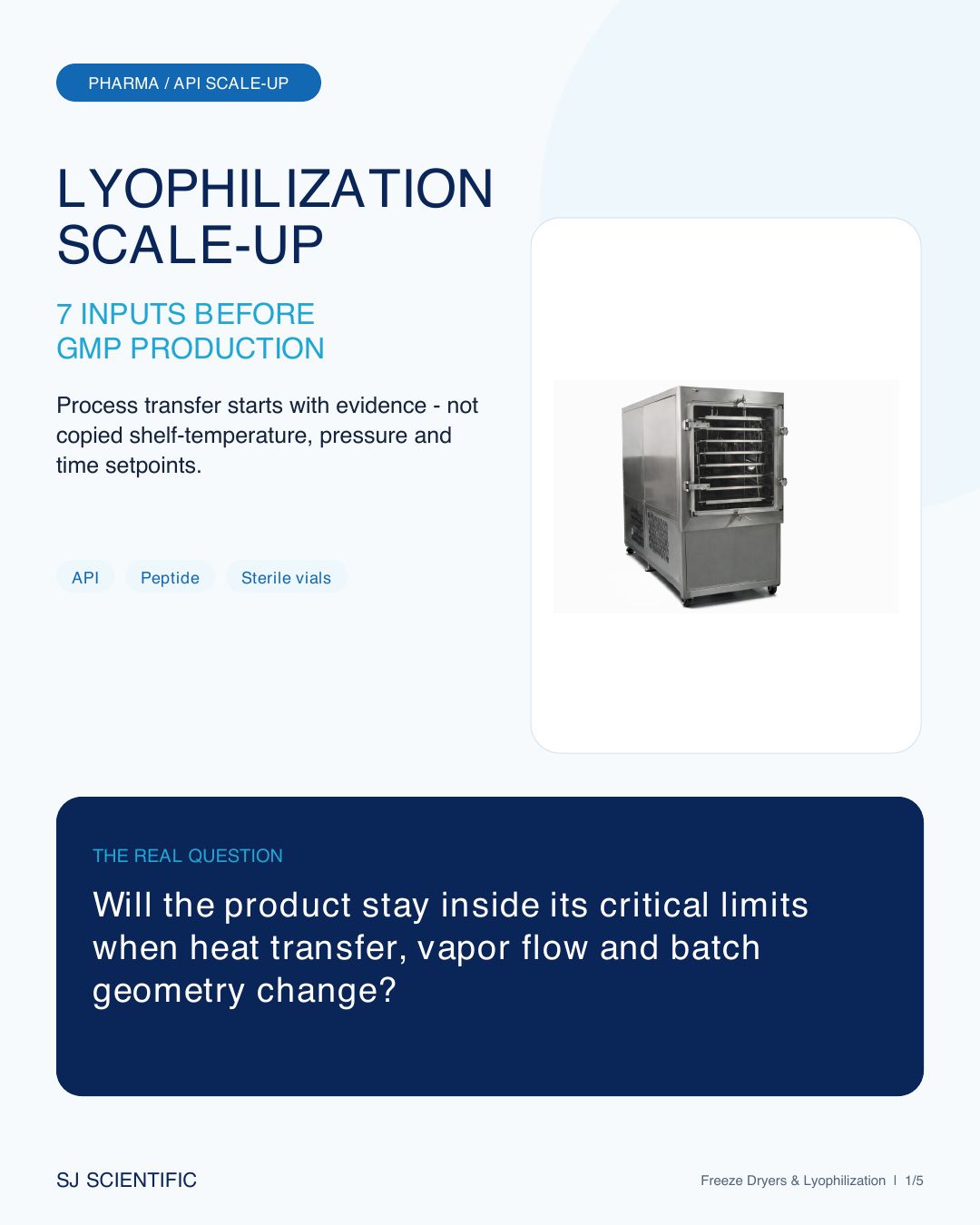
A chamber size and nominal vial count are not enough to compare pharmaceutical lyophilization proposals. One quotation may include a different condenser duty, loading method, control package or documentation scope. A short responsibility record exposes those differences before they become installation or qualification gaps.
An English slide-based engineering overview of product limits, container geometry, ice load, endpoint evidence and URS scope. Not a validated cycle.
Responsibility questions for the URS review
| Product owner | Who approves formulation limits, solvent information, endpoint and analytical requirements? |
|---|---|
| Equipment supplier | Which configuration, drawings, inspection records and agreed factory tests are included? |
| Facility team | Who provides utilities, loading interfaces, access, exhaust and drainage arrangements? |
| Quality team | Who approves protocols, acceptance criteria, deviations and qualification conclusions? |
Fix the process basis before accepting a capacity statement
Define vial and stopper drawings, fill volume, batch range and total water or solvent load. Ask the supplier to identify assumptions behind the proposed layout and condenser selection. Keep geometric positions distinct from approved process capacity.
For API manufacturing with organic solvents, resolve compatibility and safety requirements before treating an aqueous freeze-dryer proposal as suitable. Record open technical questions rather than replacing them with a general pharmaceutical label.
Draw the aseptic and loading boundary
State whether the intended process is sterile or non-sterile. Identify responsibility for filling, transfer, any barrier system, loading, backfill and closure. Review operator access and maintenance access alongside the process flow.
Neither a GMP product name nor a stoppering mechanism demonstrates aseptic performance. The project must define its contamination-control requirements and the evidence needed for the installed arrangement.
List options as deliverables, not labels
If CIP/SIP, audit trails, electronic signatures, batch reports or access controls are required, identify their actual function and acceptance evidence. Define the requested 21 CFR Part 11-related scope with the responsible quality team.
Do not assume that a brochure reference makes every option standard. Quote exclusions, software configuration, interfaces and documentation responsibilities should be visible beside the commercial offer.
Plan the handover from FAT to the site
Agree which tests can be performed at the factory and which require the installed facility, utilities or representative product. Name the protocol owner and approver and define how changes and deviations will be recorded.
Installation and operator familiarization are not process validation. Keep commissioning, qualification and product-process evidence distinct, with their respective responsibilities and acceptance criteria.
Use the checklist for a focused supplier discussion
The linked SJ slides summarize product and formulation limits, vial and stopper drawings, fill and batch data, water or solvent load, endpoints, the aseptic/loading boundary, and qualification/data-integrity scope. Send those seven inputs for a Command Flexible configuration review.
The overview does not specify a validated recipe, a guaranteed cycle time or automatic compliance. Its purpose is to make the next engineering conversation specific enough to produce a reviewable proposal.
Process-transfer questions
Does a GMP freeze dryer include all qualification work?
Only the contracted scope is included. Agree documents, tests, execution responsibilities and approval at URS and quotation review.
Can vial count alone be used to compare proposals?
No. Compare the approved container layout, fill and water load, condenser and vapor-removal capability, loading interface and required documentation on the same basis.