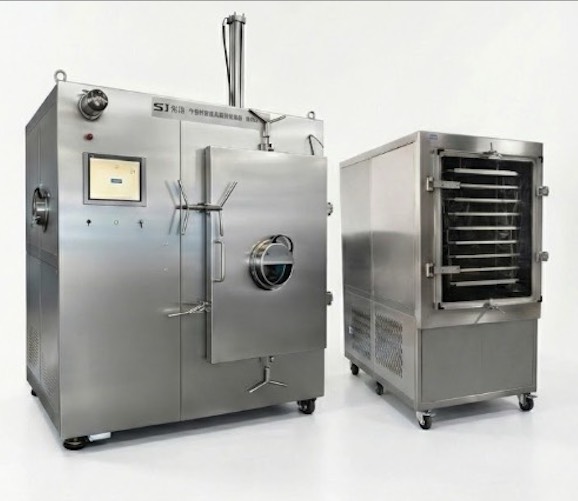
A public SJ workshop video presents the Command range from 0.5 to 5.4 m2. That scale comparison is useful for orientation, but shelf area does not select a pharmaceutical freeze dryer by itself. This guide converts the visual range into a URS decision path without claiming a formulation, validated cycle, fixed vial count or delivery time.
A real SJ workshop-based overview of five pharmaceutical lyophilizer scales. Final configuration depends on vial format, ice load and validation scope.
Use shelf area as an envelope, not the answer
The public platform classes are 0.5, 1.0, 2.16, 3.6 and 5.4 m2. They provide a first comparison between pilot, small production and larger commercial systems.
A shelf-area class does not define batch quantity. Vial outside diameter, half-stopper height, edge clearance, loading method, probe and sample positions and breakage allowance all affect usable positions.
Calculate the real process load
Provide minimum and maximum vial count, fill range, formulation solvent or water basis and total ice. Estimate the expected vapor-release profile or provide development evidence where available.
Condenser selection must address both total ice capacity and peak capture duty. A large shelf surface with a small fill can be a different engineering problem from a dense high-fill batch on the same shelf area.
Match shelf stack and stoppering to the container closure
Review vial and stopper drawings, partially inserted height, shelf pitch, loading trays or tools, hydraulic stoppering travel, backfill basis and representative-container tests.
High-density shelf stacks can improve geometric positions but reduce clearance. The approved configuration must keep loading, stoppering and tolerances workable for the exact components.
Define cleanroom, CIP/SIP and automation interfaces
State door arrangement, barrier or line connection, loading direction, product-facing materials, cleaning and sterilization boundary, drainability, utilities and maintenance access.
Describe recipes, roles, audit trail, data export, backups, time synchronization and interfaces with the site system. “Part 11 ready” only becomes meaningful when the intended workflow and validation responsibilities are defined.
Select the platform with a traceable URS review
Compare each candidate against process margin, facility fit, project interfaces, FAT/SAT, qualification documents and lifecycle service. The largest model is not automatically the lowest-risk choice.
Freeze final shelf count, condenser, refrigeration, pumps, stoppering, controls and documentation in the approved technical agreement. Customer IQ/OQ/PQ and product validation remain outside a workshop overview.
Frequently asked questions
Does 5.4 m2 mean the highest vial count is always the best choice?
No. The right platform balances batch demand, vial geometry, fill, total ice, peak vapor, shelf spacing, loading, stoppering, facility interfaces and validation scope.
Are the five Command sizes validated for every peptide or injectable?
No. The equipment platforms can be configured for regulated projects, but the customer must develop and validate the product process and complete the applicable qualification lifecycle.
This page provides general engineering and operating context. The model-specific manual, approved site procedure, technical agreement and product validation take priority.